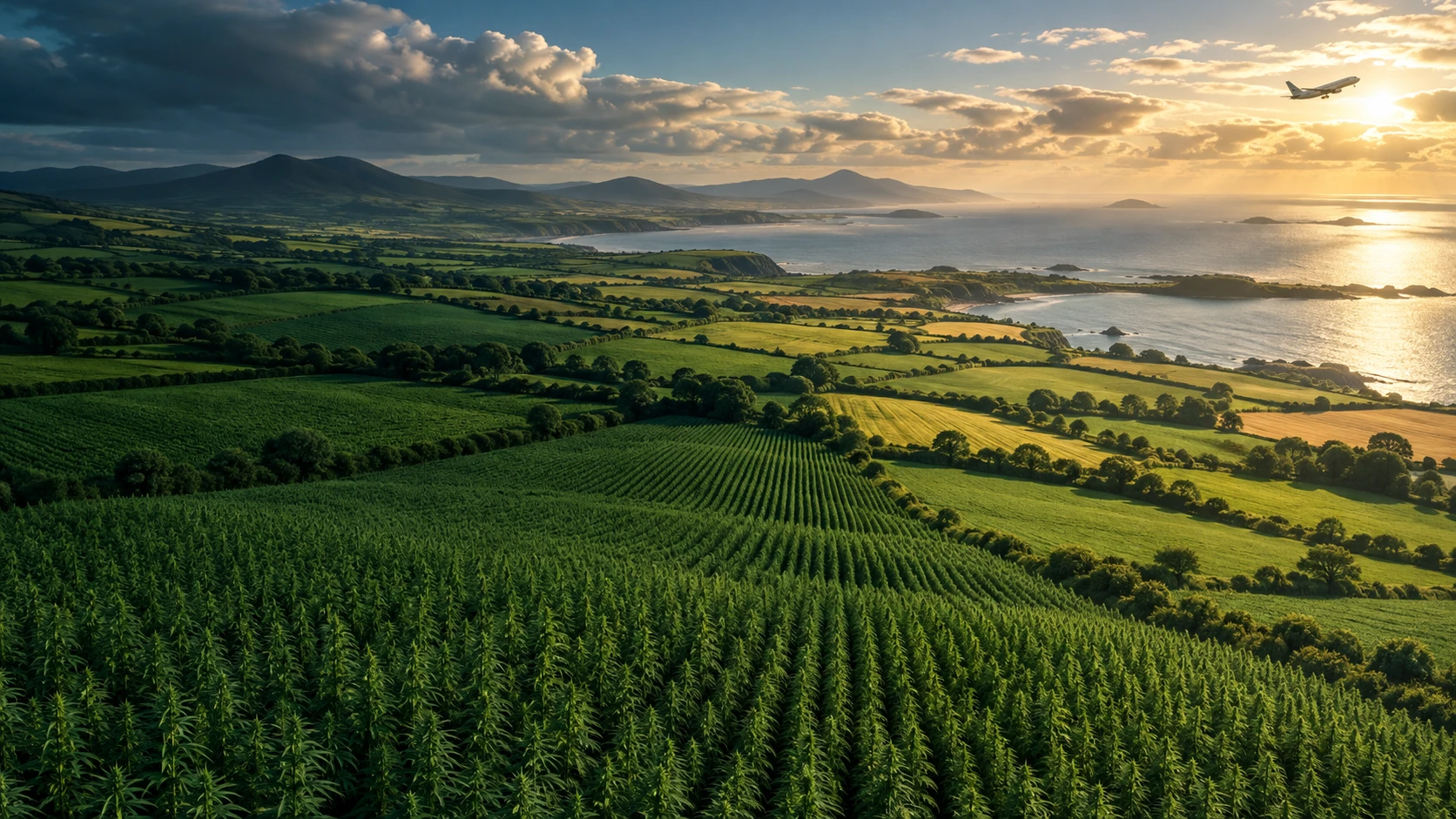
Scale-up concept · Seeking development partners
One landscape.
Two climate pathways.
Explore an integrated hemp supply system combining a biochar pathway with a separate aviation-fuel pathway.
Discuss funding1,000-hectare hemp bioeconomy
From inputs
to evidence.
Inputs
The base scenario assumes 18,000 tonnes of dry whole-crop biomass from 1,000 hectares, with 9,000 tonnes allocated to fuel production and 9,000 tonnes to biochar.
Outputs
The model applies 180 litres of SAF per dry tonne to the fuel stream, and a 30% biochar yield to the pyrolysis stream. These produce the indicative outputs shown above.
- 01Grow and harvest biomass
- 02Allocate separate streams
- 03Convert fuel feedstock
- 04Pyrolyse biochar feedstock
YIELDS AND ASSUMPTIONS
All figures are preliminary modelling assumptions requiring field and conversion validation. The paper also applies a 2.8 t CO2-per-tonne-of-biochar factor, giving 7,560 tonnes of indicative gross CO2-equivalent storage potential. This is not a verified net removal estimate; lifecycle emissions, stability, additionality and end use must be assessed.
This whole-crop scenario is distinct from the 500-tonne stalk-residue research project. It cannot inherit that project’s feedstock eligibility or yield assumptions. Fuel benefits and carbon removal must be accounted for separately.
BUILD IT WITH US
Your next climate investment
could start here.
Help turn a scale-up concept into a validated development case. We are seeking partners with feedstock, conversion, research, engineering, funding or future offtake capabilities.
Detailed methods, budgets and commercial terms are shared separately following Tao approval.
Basis: Tao Climate Economic and Scientific Review, Dr Stefan Meyer, 19 June 2026. Proposed activity, subject to funding, agreements and validation. AI-generated illustrative imagery.